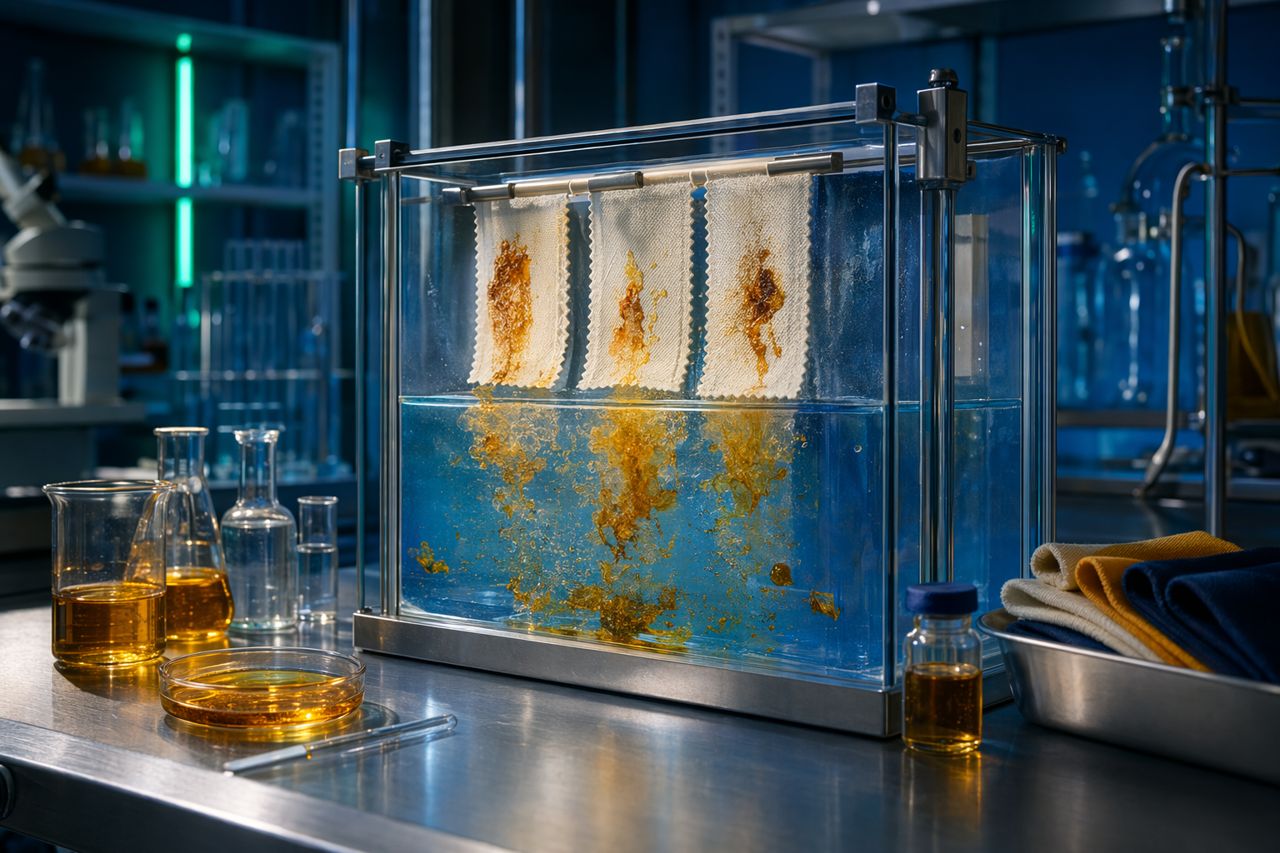

For laundry and pretreatment product makers who need a lipase that removes oily and greasy stains in their own wash conditions. Wholesale supply is quoted per order against your product format.
Request a quote: send the product you make, the quantity per order or per month, and the destination country. Request a quote
Lipase for Fat Stain Removal
Fat stains are not one material. Cooking oil, butter, sebum, cosmetic residues, motor-adjacent grease, and oily food soils all behave differently in wash liquor. What they share is interfacial behavior: they cling to fibers, spread into films, trap pigments, and resist water-based removal.
Lipase gives detergent systems a biochemical tool for that interface. Lipase, properly known as Lipase (triacylglycerol acylhydrolase), catalyzes the hydrolysis of triglycerides into more removable fragments, helping the wash system lift and disperse oily soils instead of only pushing them around.
Why lipase matters in fat-stain cleaning
Most detergents already contain surfactants, builders, polymers, and alkalinity to wet, emulsify, and suspend soil. Lipase adds a different mechanism: it acts directly on triglyceride-based soils at the oil-water boundary.
In practical formulation terms, lipase can help improve:
- Removal of greasy food stains such as butter, cream sauces, salad dressing, cooking oil, and fried-food residues
- Sebum soil reduction on collars, cuffs, pillowcases, towels, sportswear, and underarm zones
- Cleaning at lower wash temperatures, where fats are less mobile and surfactant-only systems may struggle
- Mixed stain performance, especially oily stains carrying particulate matter, color bodies, or protein residues
- Post-wash freshness, by reducing lipid residues that can retain odor precursors
The value is not just visual stain lift. It is cleaner fiber surfaces, reduced oily hand-feel, and better compatibility with modern energy-saving wash habits.
How lipase works on fabric soils
Triglyceride soils are hydrophobic and tend to form persistent films on cotton, polyester, and blended fabrics. Lipase acts at the interfacial zone where oil meets water. The enzyme binds near the lipid surface and catalyzes cleavage of ester bonds in triglycerides.
This conversion produces smaller, more polar lipid fragments that are easier for the rest of the detergent system to emulsify, disperse, and remove. In a complete detergent formula, lipase does not replace surfactants; it makes the surfactant package work harder and more selectively on the oily fraction of the soil load.
The cleaning sequence
- Wet-out: surfactants lower surface tension and open access to oily soil.
- Interfacial contact: lipase reaches the lipid-water boundary.
- Triglyceride conversion: fat molecules are cut into more removable fragments.
- Lift and dispersion: surfactants and polymers carry fragments away from the textile.
- Anti-redeposition support: the formula keeps released soil from returning to fibers.
Detergent formats where lipase is used
Lipase can be considered for a wide range of laundry and cleaning products where oily soil is a defining challenge.
Laundry powders
Powders often provide strong builder systems and robust alkalinity. Lipase selection should focus on storage stability, granule protection, compatibility with bleaching systems, and performance after dissolution.
Liquid laundry detergents
Liquids require close attention to enzyme stabilization, water activity, solvent system, preservative compatibility, and surfactant balance. A stable liquid lipase system should protect enzyme integrity while maintaining good stain access in the wash.
Unit-dose and concentrated formats
Highly concentrated systems can be chemically demanding. Lipase fit depends on formulation architecture, moisture management, packaging compatibility, and the interaction between enzyme, surfactants, solvents, and adjuncts.
Pretreaters and stain removers
Pretreatment formats can give lipase more contact time with oily soil before the main wash. They are especially relevant for food grease, collar grime, body oils, and mixed stains on durable fabrics.
Institutional and commercial laundry
In hospitality, healthcare-adjacent textile care, food service, gyms, and workwear programs, lipase can support more consistent oily-soil removal across repeated wash cycles and high soil loading.
What performance teams should measure
For B2B detergent development, lipase evaluation should be tied to application outcomes, not just enzyme identity. Useful performance indicators include:
- Stain removal improvement on representative oily food stains
- Sebum soil reduction on collars, pillowcases, towels, and synthetic blends
- Performance at target wash temperature and cycle length
- Cleaning under local water hardness and machine conditions
- Retention of whiteness and brightness after repeated washes
- Reduced oily residue and improved fabric freshness
- Compatibility with bleaching, fragrance, optical brighteners, and polymers
- Storage stability in the finished detergent format
A strong screening panel should include both standardized stain swatches and real consumer or institutional soils. Lipase performance can vary with fabric type, surfactant structure, pH, water hardness, and wash mechanics.
Formulation factors that influence lipase performance
pH and alkalinity
Many detergent systems operate under alkaline conditions. Lipase selection should match the finished product environment and the in-use wash liquor, not only the theoretical optimum of the enzyme.
Temperature profile
Modern laundering increasingly uses cooler cycles. Lipase can be valuable when fat mobility is limited, but the chosen enzyme must still interact effectively with the lipid interface under realistic wash conditions.
Surfactant system
Anionic, nonionic, amphoteric, and soap-based surfactant systems can change interfacial access. Some systems expose lipid surfaces more efficiently; others may restrict enzyme contact. Lipase should be tested inside the actual surfactant chassis.
Builders and water hardness control
Hard water affects surfactant efficiency, soil dispersion, and fatty material behavior. Builders and chelants can improve the surrounding cleaning environment, helping the enzyme contribution show up more clearly.
Oxidants and bleach systems
Bleach can be important for color-body removal, but oxidizing chemistry may challenge enzyme stability. If lipase is used with bleach, protection strategy, sequence of release, and finished-product storage conditions matter.
Protease and multi-enzyme systems
Greasy stains often contain protein and starch components. Lipase is frequently evaluated alongside protease, amylase, mannanase, or cellulase depending on the stain spectrum. The goal is not enzyme stacking for its own sake; it is targeted coverage of the soils that define the product claim.
Application fit by stain type
| Stain or soil type | Lipase relevance | Formulation note |
|---|---|---|
| Butter, cream, sauces | High | Often mixed with protein or starch; multi-enzyme systems may help |
| Cooking oil and fried-food residues | High | Requires strong emulsification after enzymatic conversion |
| Collar and cuff grime | High | Sebum plus particulate soil; anti-redeposition is important |
| Cosmetic oils and body-care residues | Medium to high | Performance depends on waxes, silicones, pigments, and fabric type |
| Motor grease and mineral oils | Limited to selective cases | Lipase targets triglyceride-like substrates, not all petroleum soils |
| Aged oily stains | Variable | Oxidized or polymerized fats may need pretreatment and stronger surfactant support |
Common buyer questions
Does lipase remove all grease?
No. Lipase is most relevant to triglyceride-based fats and related ester-containing lipid soils. Petroleum-derived greases, silicones, wax-heavy residues, and oxidized films may require different chemistry.
Can lipase replace surfactants?
No. Lipase works best as part of a detergent system. Surfactants, builders, polymers, and wash mechanics still carry the released soil away from the fabric.
Is lipase useful in cold wash products?
Often, yes. Cooler cycles make fat stains harder to mobilize. Lipase can support removal by changing the soil chemistry at the interface, but the enzyme must be selected and formulated for the intended wash profile.
What makes a detergent lipase commercially successful?
Commercial success depends on more than catalytic function. The enzyme must be compatible with the product format, stable through distribution, effective under local washing conditions, and able to deliver visible benefit against the target stain panel.
What to specify when sourcing lipase for fat-stain removal
When discussing lipase for detergent development, prepare the following information:
- Product format: powder, liquid, unit-dose, pretreatment, or institutional detergent
- Target market wash habits: cold, warm, short-cycle, handwash, or machine wash
- Key soils: food grease, sebum, body oils, cosmetics, restaurant textiles, or workwear
- Fabric focus: cotton, polyester, polycotton, synthetics, towels, uniforms, or linens
- Formula environment: pH range, surfactant class, bleach presence, solvents, and water content
- Stability expectations: ambient storage, accelerated storage, and packaging conditions
- Claim priority: stain removal, freshness, low-temperature cleaning, sustainability, or premium performance
This information allows a lipase recommendation to be matched to the real detergent system instead of treated as a generic additive.
Request a quote or get pricing
Tell us what you are formulating and what oily soils you need to win against. Lipase Enzyme Solutions will route your request to its own technical and commercial team for lipase options suited to your application.
Request a bulk lipase quote
Wholesale and bulk supply for manufacturers, formulators and resellers. To get a quote, send the product you make, the quantity per order or per month, and the destination country, and tell us your application and preferred format (powder, liquid or granule). Pricing, pack format and lead time are quoted per order, and we tell you which documents are available for that grade.